The engineering conflict: Eco-friendliness vs. performance loss
The industry shift from solvent-based systems to Polyurethane Dispersions (PUD) is driven by the need for lower VOCs and improved human health. However, this transition often forces a compromise in material integrity, as standard water-based adhesives frequently lack the adhesion and durability of their solvent-based predecessors. Traditionally, introducing aromatic rings to recover these properties spikes viscosity and melting points, necessitating the use of hazardous solvents like NMP or MEK during manufacturing—undermining the primary goal of the transition.
The Kuraray’s solution: "Solvent-like" integrity in a water-based format
Water-based integrity. Solvent-level power.
By utilizing MPD-based aromatic polyester polyols, Kuraray resolves the fundamental conflict between viscosity and terminal performance. The amorphous branched structure of MPD provides manageable viscosity, even when combined with high-strength crystalline aromatic structures like Terephthalic Acid (TPA).
- Enhanced factory throughput: The intrinsic low viscosity of MPD-based aromatics enables formulations with a high solid content. Less water in the dispersion results in significantly reduced evaporation requirements, leading to faster drying speeds and increased production capacity.
- Exceptional adhesion strength: KURARAY POLYOL demonstrates a massive increase in bond strength across diverse substrates, including aluminum, steel (SPCC-SD), and PET compared to standard linear polyols.
Performance validation: Quantifying processing freedom and adhesion versatility
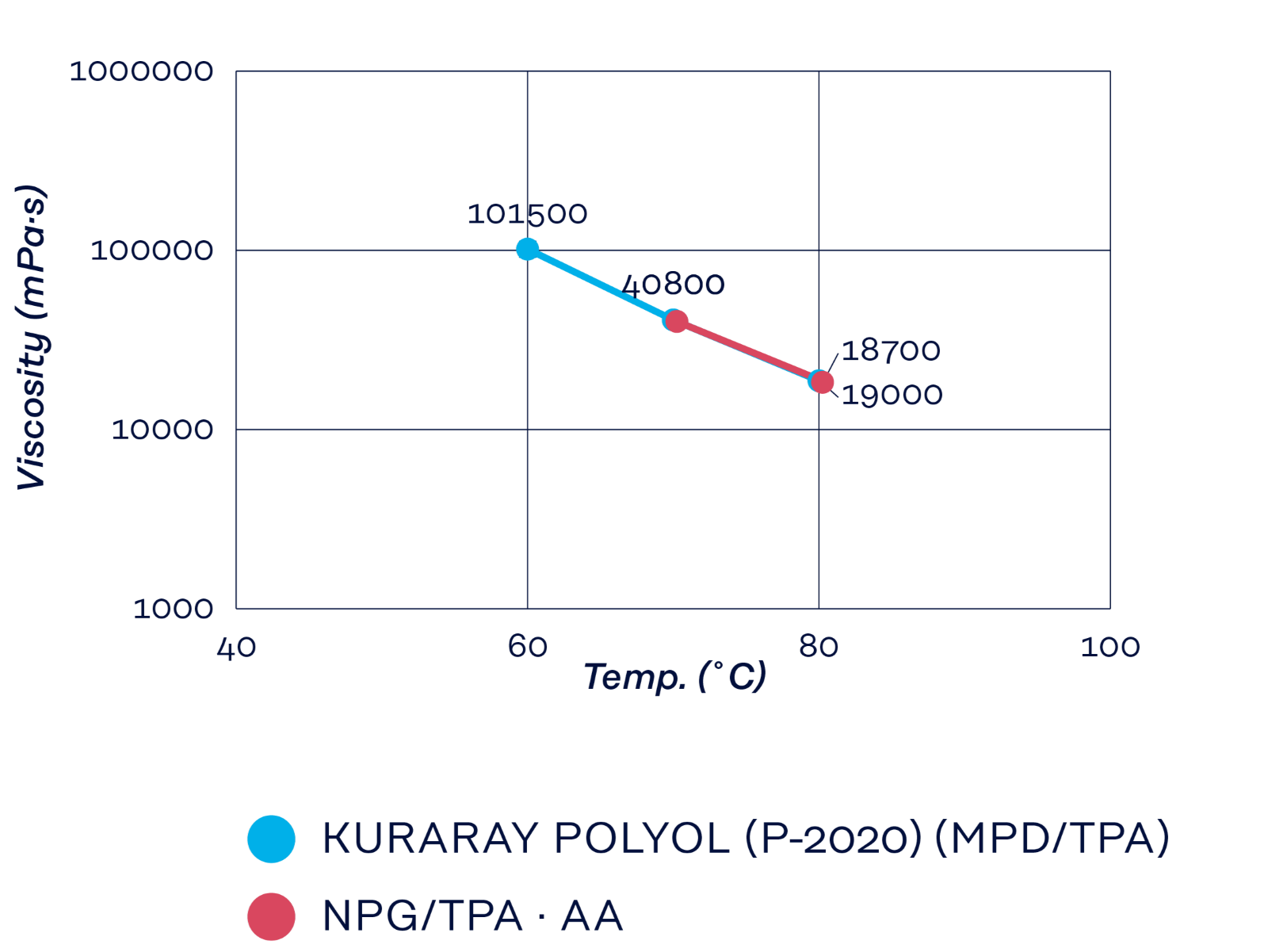
The following technical benchmarks demonstrate how KURARAY POLYOL P-2020 resolves the historical viscosity-performance trade-off. By leveraging the intrinsic liquidity of the MPD-backbone, P-2020 facilitates high-solid PUD synthesis while simultaneously enhancing initial bond strength across diverse substrates—including aluminum, steel (SPCC-SD), and PET—outperforming standard NPG-based aromatic benchmarks.
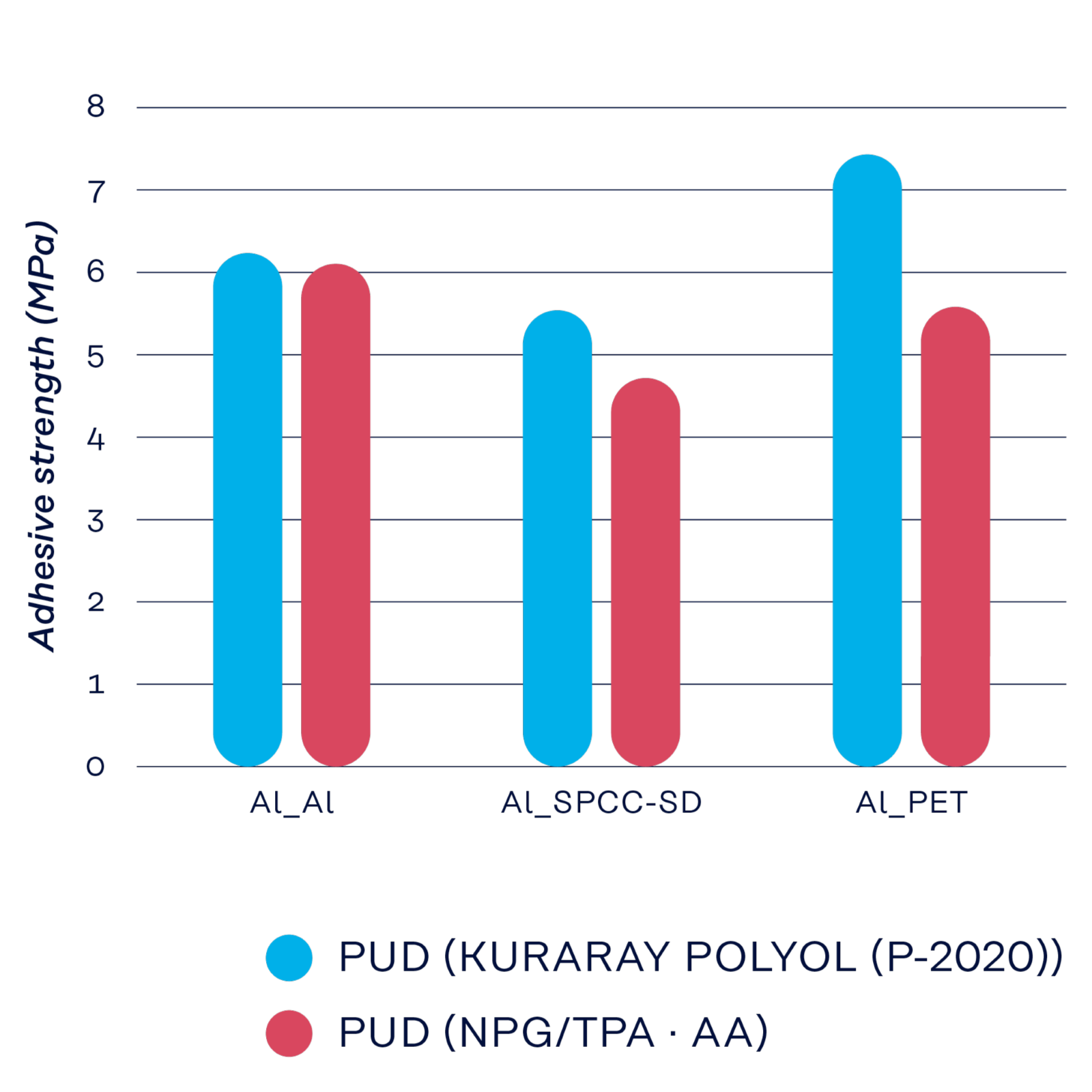
Sample condition (left graph)
Coating area: 12mm x 25mm
Adhesive layer thickness: 0.2mm
Drying conditions: RT 2h, 100°C 12h over
Tensile test condition (left graph)
Tension speed: 2mm/min
Figure 1: Unique combination of aromatic performance and low viscosity enabled by Kuraray's MPD monomer
KURARAY POLYOL P-2020 delivers a dominant viscosity reduction effect (blue line) facilitating solvent-reduced handling. Simultaneously, it secures superior adhesion across metallic and polymer substrates compared to NPG-benchmarks.
- Aromatic cohesion and resistance: The incorporation of TPA units via an MPD backbone increases π to π interactions, providing superior film strength and inhibited water ingress.
- Hydrolysis resilience: MPD-based aromatic systems maintain structural integrity under extreme heat and humidity (85°C / 85% RH) for around 1,000 hours, whereas standard aromatic benchmarks like NPG suffer catastrophic structural failure within 200 hours.
Performance validation: Benchmarking aromatic durability under extreme stress
The following accelerated aging data verifies the efficacy of the C3-methyl "Steric Shield" within an aromatic architecture. When subjected to extreme hydrolytic stress (85°C / 85% RH), P-2020 based dispersions maintain high property retention for around 1,000 hours. In contrast, industry-standard NPG-based systems undergo total hydrolytic collapse and catastrophic adhesive failure within the first 200 hours.
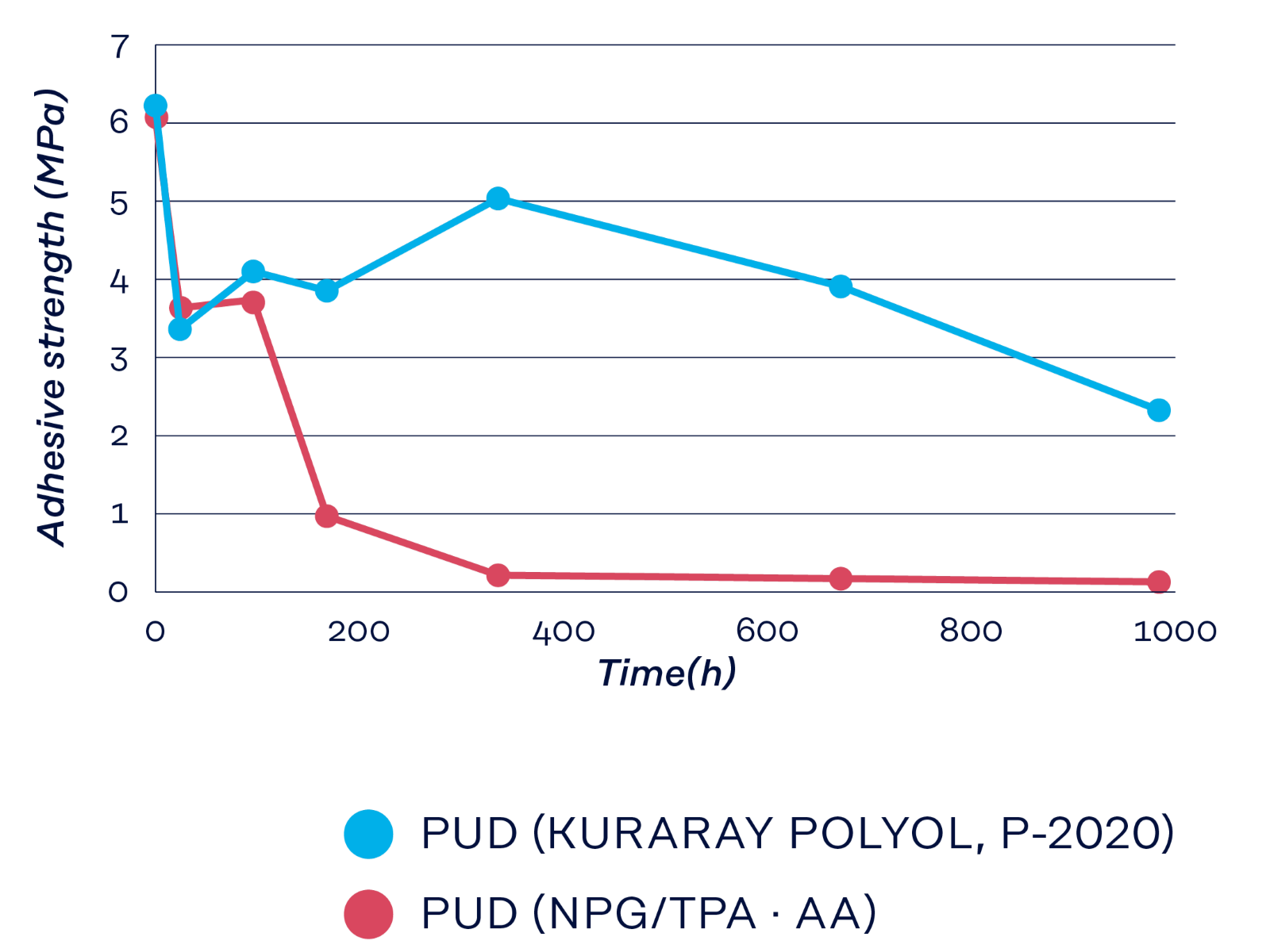
Sample condition
Coating area: 12mm x 25mm
Adhesive layer thickness: 0.2mm
Drying conditions: RT 2h, 100°C 12h over
Heat and humidity resistance test
Temperature and humidity: 85°C / 85% RH
Drying conditions: 40°C, decompression drying
Tensile test condition
Tension speed: 2mm/min
GPC condition
Solvent: DMF (+10mmol/L LiBr)
Figure 2: Long-term adhesive integrity
Under extreme heat and humidity (85°C / 85% RH), PUD made from KURARAY POLYOL P-2020 maintains functional adhesive strength for around 1,000 hours, whereas the NPG-benchmark fails to maintain structural cohesion.